Monday, December 12, 2016

"It begins with D."

There are a few things that should no longer be a surprise on this blog. One is that I will take any opportunity to discuss my favorite book series. (I have a lot of favorites, I know, but still.) In this case I am writing about Catherynne Valente’s Fairyland series. After the election, Valente tweeted a lot about Fairyland and her disappointment about current events. Not going to lie, I was disappointed too. And because good things occasionally come out of bad, my favorite story got an addition. Valente wrote “The Beasts Who Fought For Fairyland Until The Very End And FurtherStill.” I read it over Thanksgiving Break and was like, “I have to write about this, because I love it.”

Before the story, Valente says, “Ever since the election, people have been telling me to shut up and go back to Fairyland. Be silent. Be good. Accept. Submit. Stop talking about politics. Stick to fairy tales. (As if fairy tales have ever not been about politics.) Go back to Fairyland. Go back to Fairyland. So I did.”

***HERE BE SPOILERS***

This story takes place between the original prequel and the start of the actual series. We re-meet our old friends Ell, the Leopard of Little Breezes, and the Green Wind after they have suffered a defeat at the hands of the Marquess. We knew this defeat happened and we have seen the effects of it. If you’ve read the series, you know what the Marquess is capable of. And you know how Ell and the Green Wind resist. But how do they get there?

Ell, like me, like so many of us, is almost despondent: “We lost…But we tried so hard…Stories aren’t supposed to end like this… Things are supposed to get better. Things are supposed to make sense.” How could this happen? It wasn’t supposed to end up like this. How did we get here? And now what?

And like he so often has, the Green Wind has the answer: “Perhaps this is not the end of the story…” Green tells Ell about the magic of narrative and the power of making someone the hero of their own story. The Leopard of Little Breezes talks about the magic of No: “It’s very much harder to say No to a tyrant…harder still to do it while your wings are tied down…” And the magic of Yes: “We must band together, back to back, and say Yes to everyone who lost today, for we are all family now, and our loss is our new last name.”

“But most of all, we must say Yes to the truth and the speaking of it. We must say No to silence.”

Through all of this, they are speaking to us, just as they are speaking to Ell. And Ell is encouraging all of us too: “I understand what you mean…You mean defiance. I know all about Defiance. It begins with D.”

This is it. This is the lesson we all have to learn. Yes, times are rough. And they don’t look like what we expected or what we are used to. Many people find hopelessness. I find strength. There are many more of us who choose unity over hate. As more and more votes are counted and official number come out, and more news about incompetence and cronyism comes out, we see that We the People can be stronger than those who sit in the seats of power. After all, this is, supposedly, a government of, by, and for the people. So we need to say No, as long and loud as necessary. Until the “dark lord” of the story is “cast down into infinite nothingness or [is] burnt to a crisp of at the very least sent to bed without supper.”


I don’t know what the future holds, but I have found some hope and courage in this story. I hope you have too.

Tuesday, October 4, 2016

Third Quarter Recap

So, somehow it's been three months since I wrote a blog. Whoops. In my defense, I had a very busy three months. Other than working a crazy amount, I visited my best friend in NYC while she was in the States doing research, my parents visited, my best friend came to Boston, I moved, and the semester started. I've a bit of a backlog of pictures, so I'm going to share them now!

During August, one of my work friends and I had a day off together, so we went to a beach north of Boston. It was great fun that I won't be repeating for a while.

While my parents were here, we caught a Twins game at Fenway. They lost badly (one of two losses during the series, but they won the other two) and the fans were not the world's greatest examples of sportsmanship.

I worked so much over the summer that my latte art is fairly consistent... when I'm doing hearts. This was one of two leafs I was able to make. And I haven't tried again.

While my best friend was in Boston, we went to Mike's Pastry, a hot tourist spot, for cannoli. An excellent choice.

My favorite piece of art from my quick trip to NYC.

Another picture from when my parents were here. We did a brewery tour at Samuel Adams. It was pretty fun, and we got to keep the tasting glasses. Additionally, we were on the first tour of the day. At 9:40 am.

That's all I've got for now. My semester has started and is quickly picking up pace. This semester, in addition to my two classes, I have to get started on my thesis. And I've decided to apply to a few PhD programs in history. So, we'll see.

Monday, July 4, 2016

We Hold These Truths

"We hold these truths to be self-evident, that all men are created equal, that they are endowed by their Creator with certain unalienable Rights, that among these are Life, Liberty and the pursuit of Happiness."

I hope most of you recognize this as the second sentence of the American Declaration of Independence. Many of you will point out the problems of this sentence--"all men" clearly not actually meaning all men, let alone people. The presence of a "Creator" is clearly influenced by Christianity. This, shall we say, declaration is so much more than the thinkability problems of its creators. We are in the midst of a constant redefinition of who "all men" includes. Similarly, in the Constitution, "We the People" is always expanding. 

The Declaration of Independence also bases the right of governments to govern on "the consent of the governed." Those of us who are governed have the right, and the responsibility, to hold that government accountable. "It is the Right of the People to alter or abolish" "any Form of Government" which "becomes destructive" to life, liberty, and the pursuit of happiness. However, "Governments long established should not be changed for light and transient causes"--we ought to try alteration before abolition. (See my earlier post on incremental change.)

I am not saying here that we are not facing serious problems in modern America. I am proposing, that in fighting for change, we remember the ideas that the Great American Experiment was based upon, rather than focusing on the dissonance between those ideals and the lives of the men who espoused them.

To close, a quote I found from John Adams in 1818: "But what do we mean by the American Revolution? DO we mean the American war? The Revolution was effected before the war commenced. The Revolution was in the minds and hearts of the people; a change in their religious sentiments,  of their duties and obligations...This radical change in the principles, opinions, sentiments, and affections of the people was the real American Revolution."

Clearly, we are always in the midst of an American Revolution.


The Declaration of Independence: http://www.archives.gov/exhibits/charters/declaration_transcript.html

John Adams quote: http://www.deseretnews.com/top/2597/19/February-1818-25-historical-quotes-about-the-Declaration-of-Independence-July-4th-and-America.html

Monday, June 27, 2016

On Incremental Change

I'm currently a little in love with this quote from Senator Cory Booker: "We allow our inability to do everything to undermine our determination to do something." It strikes me as particularly relevant. Between the American election cycle and the EU referendum in the UK, there have been massive calls for "changes" to systems. Not just changes, but the dismantling of whole institutions. Overturning the status quo so completely, though, would lead to fall-out that would be almost entirely unpredictable. I do not propose to know what lies ahead for the UK. I do not propose to know how the outcome of the US presidential election will affect our society.

What I do propose to know is that incremental change is, in many ways, the best way to affect change. Sometimes it is necessary to work within the current system to create the new order. I have two examples in support of my point. The first is abortion access in the United States in the 1970s, but continuing today. The second is the family policies of Bolshevik Russia in the early 1920s.

It has been argued that Roe v. Wade was a massive triumph for abortion rights. Indeed, Roe v. Wade is still a significant topic in modern politics, but, in ruling its that abortion is constitutional, the Supreme Court created a platform but built with no supporting structure. Ruth Bader Ginsburg has criticized the Roe decision. And, honestly, I agree. According to this Washington Post article, the "wholesale repudiation of state abortion restrictions went too far, too fast." In addition to being too far, too fast, the decision galvanized the pro-life movement. Further, the Roe decision has been incredibly easy to undermine: between 2010 and 2014, 231 new laws were passed restricting access to abortion. Ginsburg has said Roe was centered on "the doctor's freedom to practice" rather than the ability of women to make the best choices regarding their lives.

So there are two problems here: the equal rights of women to make their own decisions about their lives and the erosion of access to safe, legal abortion. The consequence of both of these has become, over the 46 years since the Supreme Court decision, a lack of access women have to health care--especially women of color, economically disadvantaged women, and women living in rural areas.

New restrictions to abortion access are more difficult to contest. This is not a new problem--systematic oppression is more difficult to combat than overt racism, sexism, heterosexsim, or cisism. Access to safe, legal abortion is important, but the Roe declaration that abortion is constitutional did nothing to provide for the maintenance of that right.

My second example is almost a hundred years old and comes from Bolshevik Russia. I've done a bit of reading on Alexandra Kollontai and her ideas about the family in post-revolution Russia. The capitalist understanding of the family rests on the exploitation of women, and to some extent children. Kollantai wanted the institution of the family to be revolutionized--women would no longer be solely responsible for domestic work or childcare. How this would work in reality is never quite clear. Perhaps Kollantai herself wasn't sure what the new family would look like. In reality, Bolshevik leadership did not rate the family or women's equality as equal in importance to economic matters. (Sure, women were valued members of the proletariat, but they were still expected to do unpaid domestic labor, including childcare.)

The family policies of Revolutionary/Leninist Russia attempted to make life better for women. They relaxed divorce restrictions, legalized abortion, and provided for child support for divorced mothers. In reality, none of these policies worked. Early Soviet Russia had a myriad of problems. This is just one. But it highlights the problems of socialism and communism (and Bolshevism). Do you legislate for the world you believe will come into being through the revolution or do you legislate for the world you have in an effort to accomplish the revolution through governmental change?

Do you legislate for the world you have or the world you want to have?

Why not both?

The challenges facing the United States are indeed many: entrenched racism and sexism, the military-industrial complex, xenophobia and isolationist tendencies, and others. But they are not insurmountable. The first principle that we must agree on is that there is no "Us" and no "Them"--that creating an Other is a danger to us everyone. Advocating for a revolution in the form of a complete governmental overhaul, neglects the stability provided by government and the benefits that come from the system.

Some of you may argue that changing laws does not always work. I agree. But without changing the government from within, any other changes will not last. Changing hearts and minds will not matter if those changes are not in tandem with changing laws.

Some of you may argue that laws and those who enforce them are corrupt. Maybe they are. But getting rid of everything in bulk does no one good for long.

In conclusion, while my ideas and beliefs have become more radical, my understanding of how change is accomplished has become more complicated. Change is like an argument: to work, it must be constructed step by step, so the conclusion is built on a solid foundation. From that foundation we can build a better future.

Sunday, June 26, 2016

#EnoughIsEnough

A while back I wrote about gun violence and the Second Amendment. Much of what I said then I still believe. The 2013 me (when I wrote the first post) was less confident in her opinions, at least on big issues. She also didn't like to make waves. She shied away from conflict. The 2016 me, on the other hand, simply doesn't care. Sometimes you have to be decisive and confident. And, dare I say it, strident. There are issues that are impossible to stay silent on.

To the specific issue of gun violence in America. This is my original post. This is an article about Ruth Bader Ginsberg's views of the Second Amendment from the same general time. It's hard to get actual statistics for a variety of reasons. One of the most absurd of these is the ban on the CDC studying the public health effects of firearms. Gun violence in America is an epidemic. In 2016, 1,600 minors have been casualties of incidents involving guns. There have been 150 mass shootings since the start of 2016.

The massacre in Orlando has sparked something more than the resignation that, in my opinion, most people have felt recently. This massacre was a hate crime against the LBGTQ community and against Latinx people. While I may not be terribly well informed about those two communities, I have friends who are. My entire school cohort is more informed on this than I am--something for which I am grateful, because my understanding is broadened. But, as with any increase in knowledge, the capacity to be saddened increases. I am heartsore for these communities. But I am tired of grieving.

On a more hopeful note, there are some members of Congress who feel the same. And are sick of doing nothing, and so are doing something. Sen. Chris Murphy filibustered last week to get a vote in the Senate on gun control bills. Republican-led Senate leadership held the votes, which failed to pass. The bills related to background checks for internet and gun show gun sales and to baring people on no-fly lists from buying guns. While the latter of these measures is not a great bill, it is something. Thirty-seven senators participated by asking, mostly rhetorical, questions of Sen. Murphy. Some also physically stood with him-- Sen. Cory Booker was referenced in multiple speeches for his support. And, yes, I did watch a few hours on C-Span. (I would have watched more but I had to work.) As Cory Booker said, "We allow our inability to do everything to undermine our determination to do something." Which I think is relevant to most everything in the American political system. It is broken in many regards, which makes many people think that unless we completely change the entire system, there is no point in trying.

The general support for Senator Murphy included the vast majority of Senate Democrats (including Independent Sen. King). Unsurprisingly, Sen. Sanders was absent. His record on matters of gun control is vastly different from the Democrat Party platform. (On a side note, this difference is a large reason why I could not support him in the presidential primaries.) All four senators from Minnesota and Massachusetts showed up. So, even though the bills failed to pass, these senators gave me hope. Thoughts, prayers, and moments of silence are no longer acceptable. Without action, they never have been.

Which leads me to the second event that gave me hope this week. The Democrat sit-in in the House of Representatives, led by Rep. John Lewis. Civil disobedience on the floor of the House of Representatives, led by a leader of the Civil Rights Movement. I had to watch (or follow on Twitter while I was at work). Senator Murphy's filibuster was broadcast on the Senate cameras. The sit-in was broadcast on Periscope and Facebook live, via cell phone, for the most part. The Facebook video was provided by Rep. Beto O'Rourke (Texas) and the Periscope video by Rep. Scott Peters (California). When the House adjourns, the cameras turn off. Quick thinking and the presence of technology allowed the general public to be informed and support their representatives. When Speaker Ryan decided to resume activity in the House, the cameras turned back on--to chants of "No Bill No Break" (among other things). It was deafening. It was a clear picture of Congress going about its business while Americans shout for something to be done.

As with the filibuster, Rep. Lewis and others wanted votes on increased background checks and no fly, no buy, but also, I think, on a bill that would allow the CDC to research gun violence as a public health concern. There were comments on the futility of the sit-in. After all, the Republicans hold a majority in the House. But there is broad support among the public for universal background checks and bi-partisan support for the bills. However, even if the outcome was certain failure, Speaker Ryan refused to even allow for a debate. And yes, there are ways to override the majority refusing to bring a bill to vote. But still.

Currently in American politics, Democrats are discussing issues and solutions. They are trying to get things done. They are presenting solutions. Maybe not perfect ones. I forget which representative said it, but he discussed the possibility of infringing on civil liberties with the passage of no fly, no buy. But he suggested that if the civil liberties of persons on the no fly list would be infringed upon by restricting their ability to buy a fire arm, perhaps their civil liberties are being infringed upon by being on the no fly list. And, perhaps the government should re-evaluate the criteria for being placed on the no fly list. As Sen. Booker said, we cannot allow our inability to do everything stop our determination to do something.

A minor point here is that universal background checks and similar regulatory measures are supported by a majority of NRA members, but not by the men who run the organization. Men who decide which politicians receive donations from the NRA. One of the roots of the lack of congressional action on gun control is the presence of vast sums of money in politics. However, action must be taken on gun control, regardless of action on money in politics. Although, reforms in campaign finance would help.

A further point on gun regulation: universal background checks and similar measures are just that: regulations. The Second Amendment is for a "well-regulated militia"--setting aside the militia part, we are still left with "well regulated." Allowing anyone to buy a gun on craigslist, no questions asked, is pretty much the opposite of "well-regulated."

If your point is that criminals will still get guns and the only way to stop a bad guy with a gun is a good guy with a gun, you are wrong. The "good guy with a gun" story is a myth. And just because we can't stop criminals from getting fire arms, doesn't mean we shouldn't do something. Some one who wants to commit murder can still achieve it regardless of increased gun control laws. But maybe it should be more difficult to acquire a weapon.

One last point. Your "right" to bear arms, including what are essentially weapons of mass destruction, ends when it hits the right of everyone else's' right to "life, liberty, and the pursuit of happiness."


Sources:
http://abcnews.go.com/Health/cdc-launched-comprehensive-gun-study-15-years/story?id=39873289

http://www.gunviolencearchive.org/

http://www.slate.com/blogs/the_slatest/2016/06/15/connecticut_s_chris_murphy_democratic_senators_filibuster_on_gun_control.html

http://www.gq.com/story/elizabeth-warren-and-cory-bookers-speeches-gun-violence-filibuster

My last idea has been influenced by this quote.

Friday, June 24, 2016

Update and Such

Hello all. I know I've been lax in writing recently, but life has been busy and rather monotonous. However, I find myself with a little time this weekend so I'm going to write a few posts. This first one will simply be an update. I might make a separate picture update, but as I load a lot of pics to twitter and instagram, and I'm not sure where my card reader is, I might not.

My school year ended well. I'm looking forward to the next year. I applied for a funded research seminar for my thesis and got it. My thesis is going to be about the gaps in modern feminism, specifically relating socialist feminist thought and historical figures. I want to look at actual historical women, how their ideas were erased from second wave feminism and how that erasure continues to impact third wave and modern feminism. It's a big project, but I have a start on it because I wrote my history paper on the general topic. I'm also quite excited for it.

This summer I am working a lot. Not only am I working as a barista, which I generally enjoy, but also I am doing research with a friend/my roommate for a faculty member at Simmons for a new edition of a textbook. Both of these will continue in the fall.

The last part of this update is a bit of a disclaimer. My next few posts will likely be about politics or current events. I know some of you will disagree with me, and I'm willing to discuss differences civilly. But, for some of these topics, I don't care about some opinions and I am in no way obligated to listen. And on some level, I just don't care.

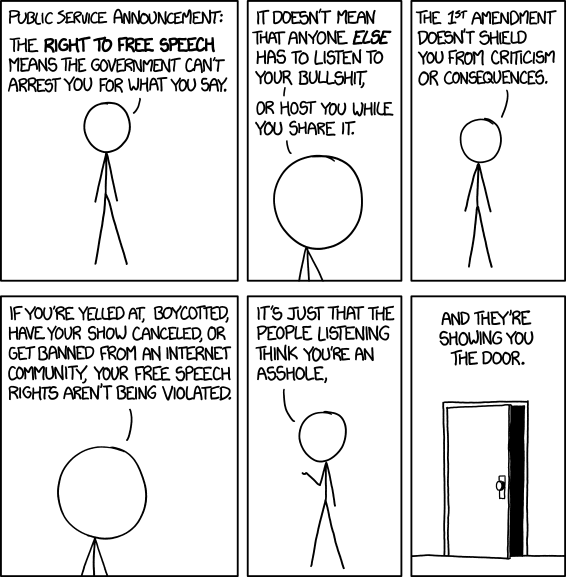
Free Speech

Courtesy of: https://xkcd.com/1357/

Sunday, May 8, 2016

On Mothers

I’m told that today is mother’s day.
As though one day a year is enough
To praise not just my mother
But all mothers.

Mother’s day.
What a lame concept.
As though women are just mothers.
My mother is more than that.

Mother’s day.
What capitalist patriarchal hogwash.
If society cherishes mothers so much,
Why are they not extolled?

Sure, in Christianity,
Mary is the Mother of God.
Blessed among women.

And what of the women who are not mothers?
Do we forget them?
Are they unintelligible?
Only to society.

I give thanks almost daily for my mothers.
Not just the woman who birthed me.
But her mother. And my father’s.
And all the way back.

They are not my only mothers.
I am the daughter of every woman
Who had to fight to be heard.
Who was force-fed in prison
For wanting to vote.
Who was forced behind a man
Even when her ideas
And discoveries
Saved us all.

I stand on the shoulders of all womankind.
And I try to pull my sisters up with me.

That we may rise.